3 short experimental videos, 2024
• Art direction and music: Nicolas Bernier• Visual programming: Jean-Philippe Jullin
A series of 3 short experimental videos part of the VISIONS COULEURS project.
The project is nourished by scientific and experimental readings on flicker-induced hallucinations and other consciousness expansion (notably Walter 1953, Huxley 1956, Kast 1964, Blewett 1969, Bartossek & al. 2021, Makin & al. 2023) while graphically inspired by theories of color and optics — in particular that of Newton and Geothe.
Long list, Aesthetica Art Prize, 2025 /UK
performance, 2024
• Art direction and music: Nicolas Bernier• Visual programming: Jean-Philippe Jullin
VISIONS COULEURS is solo for synthesizer and colors. To allow the performer to PLAY colors like one plays music, the sonic parameters of a small modular synthesizer are closely mapped to video program audio-reacting to the synth sounds.
The project proposes an experience of non-stop bursts of sounds and vivid colors, comprovised in real-time on a modular synthesizer.
sound and light performance, 2017
• Art direction, design and sound composition: Nicolas Bernier• Technical assistance: Pipo Pierre-Louis
• Production: Nicolas Bernier
transfert (299 792 458 m/s) is marking a shift from Nicolas Bernier's previous conceptual and rather minimalist series, frequencies. From the white scientific background, Bernier is now taking a turn towards science fiction and the oversweet 80s pop culture. The piece is driven by loads layered synthesizers recalling sci-fi soundtracks that are animating coloured neons at the speed of light. Somewhere between the spacetime travel light beams or the spaceship control panels and corridors, the 3 scenographic structures are moved by the artist, altering the perception of light and space.
transfert (299 792 458 m/s) is a hyperbolic, artificial science fiction scene.
Finalist, Arte Laguna Prize, 2018 /IT
sound and light environment, 2017
• Sound, light, scenography and art direction: Nicolas Bernier• Technical assistance: Pipo Pierre-Louis, Daïmôn
• Production: Daïmôn, Nicolas Bernier
A clock tower of a former train station filled with smoke drifts and coloured lights is synced with a generative sci-fi inspired soundtrack. When the night takes over, this irregular object gradually appear within the urban landscape, acting as a metaphor of the surnatural, of parallel dimensions within our world. In a constant gaseous state, the object is unaccessible to anybody, but yet, its presence is strong. Somewhere between the sea of Solaris, the monolith of «2001» or Stranger Things' castle Byers, the self-generative audiovisual composition creates contrasting presence that seems to have its own life, opening a new perspective within the urban landscape. In situ: Hull, Québec.
Commissioned by Daïmôn
_
Thanks to Raphaël Néron Baribeau for the invitation and to La petite G'ART and Daïmôn for their generosity.
light object, 2017-Ongoing
• Art direction and design: Nicolas Bernier• Fabrication: Robocut
• Technical assistance: Pipo Pierre-Louis
• Production: Nicolas Bernier
Between the finite and the infinite, these miror structures are reflecting the outside world until they are set in motion to unveil a moving and infinite interior. Hidden inside are superimposed diagrams reinterpreting certain theories or hypotheses related to our scientific apprehension of the world. Between transcendental geometry, higher dimensions, finite and infinite, these structures arise as objects of reflection on what one understands, what one believes to understand and what one does not understand. The structure is thus refering to the finite physical structure that is encapsulating the infinity of intellectual structures created by the humankind.
Part of an ongoing series (objects are fabricated one by one on demand), this first structure is based on the Feynman Diagrams about quantum fields.
_
Available for acquisition: liste@nicolasbernier.com
Finalist, COCA Art Prize 2019 / IT
Shorlisted, Aesthetica Art Prize 2018 / UK
Electronic music ensemble, 2016-Ongoing
• Direction: Nicolas Bernier• Support: UdeM, FRQ-SC (2016-19)
Since 2016, this sine wave ensemble allowed the creation of more than 20 pieces. Initially thought as a space to think and explore the most basic sound, the 10 musicians utilize post-wars oscillators as musical instruments. Taking inspiration in early electronic music (like Pauline Oliveros or Karlheinz Stockhausen), the ensemble is building a massive body of work including new pieces by Francisco Meirino, Cat Hope, Hervé Birolini and interpretations of Candas Sisman, Sébastien Roux and electronic music pionneer Else Marie Pade. The project lead the way to a wider research projet Towards a Sine Wave Aesthetic.
Complete documentation including scores, articles and tools:
https://lfo-lab.ca/ensemble-oscillateurs
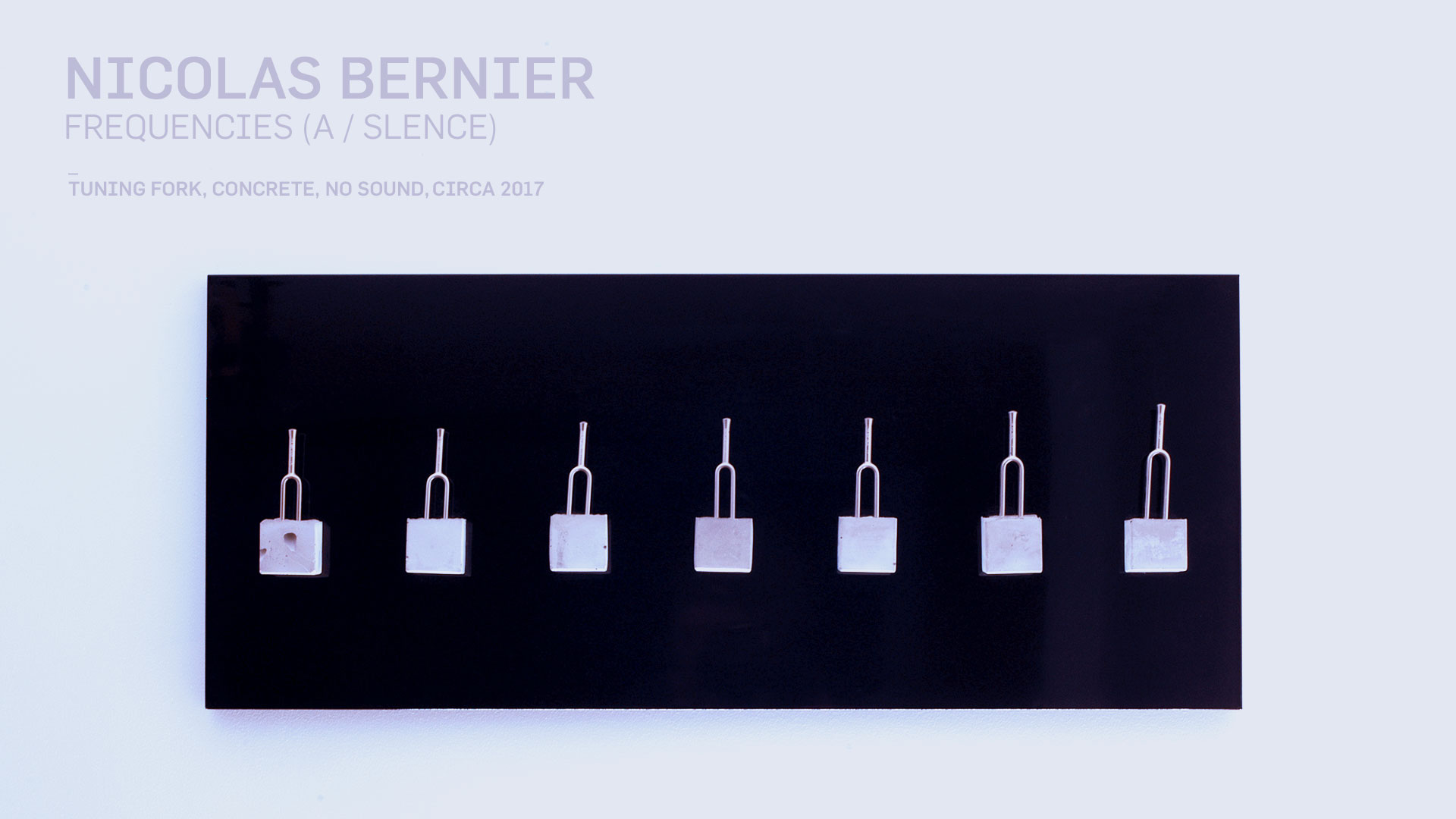
Tuning forks, concrete, no sound, circa 2017
• Art direction and design: Nicolas Bernier• Fabrication: Robocut
• Production: Nicolas Bernier
After near a decade creating works with tuning forks I wanted to restrain myself from using it. I wanted to make sure I would explore new grounds beacause I could have used tuning forks my entire life. I did two main actions in that direction : the first one was to give away my tuning forks with the release of frequencies (a / friction) on the label 901 Editions. What was left of my collection was then poured in concrete and fixed on a frame. They now hang on a wall. I haven't use the tuning fork in any new work since then.
Available for aqcuisition write to liste@nicolasbernier.com
Sound and light experiment, 2016
• Art direction and design: Nicolas Bernier• Fabrication: Robocut
• Production: Nicolas Bernier
A laser beam is tracing a waveform on a wall by following the movement of a motorized rotating tuning fork. Usually associated with electronic and digital visualization, the waveform generated in frequencies (a / oscillation) is completely analogue: it shows the direct motion of the tuning fork by using the y axis (amplitude) activated by a solenoid combined by the x axis (time) generated by a step-motor. Thanks to the retinal stain, our perception will enable to visualize the movement, the waveform, traced the laser. The installation is drawing from the experiments of 19th century physicist Jules Lissajous who first discovered this method for visualizing sound.
Long list, Aesthetica Art Prize, 2017 /UK
Collection Galerie de l'Université de Montréal
Sound and light instrument, 2016
• Art direction and design: Nicolas Bernier• Fabrication: Robocut
• Technical assistance: Pipo Pierre-Louis
• Production: Nicolas Bernier
Seven electromagnetically driven tuning forks generating continuous acoustic drones by help of a custom keyboard/controller turning each frequencies on and off. The project is a poeticized take of the technical device invented in the late 19th century by physicist Hermann von Helmholtz (1821-1894) who created what can be seen as the very first synthesizer. Combining sound with slow light pulsation patterns, this acoustic additive synthesizer is creating a contemplative and intimate experience.
Collection Galerie de l'Université de Montréal
Sound and light experiment, 2015
• Art direction and design: Nicolas Bernier• Fabrication: Robocut
• Technical assistance: Pipo Pierre-Louis
• Production: Nicolas Bernier
On a table is an old oscillator connected to a speaker and a 480 Hz tuning fork. The oscillator frequency is stable at 476 hz. When the tuning fork is aleatorically struck by the solenoid, a beating pattern appears. We then hear the friction between the two oscillations, the friction between the electronic and the acoustic, the friction between different periods of the history of sonic research. This humble piece is an homage to two people I admire : sound artist Alvin Lucier (1931-) who worked extensively with oscillators and physicist Hermann von Helmholtz (1821-1884) who used the tuning forks for sound analysis and who was among the first to theorize on the beating patterns between frequencies. _
Collection Espace Gantner / FR
_
Merci à Caroline Traube (UdeM) pour le diapason.
Sound and light object, 2014
• Art direction, sound composition and design: Nicolas Bernier• Vox: Dominique Bernard
• Fabrication: Robocut
• Technical assistance: Pipo Pierre-Louis
• Co-production: Electroni[k], Nicolas Bernier
Composition based on sounds from the scientific archives of Rennes 1 University (France), an impressive collection of antique scientific apparatus that includes one of the few remaining « Grand diapason » built by Rudolph Koenig circa 1880. This Grand diapason, resonating between 32 to 48 hertz, can (barely) be heard in the composition, among other sounds from the archives, mainly tuning forks. The piece could metaphorically be seen as a sonic bridge between past and present, as a lullaby in memory of those scientists, inventors and objects to whom we owe the history of sonic research.
The piece is meant for an intimate listening through a unique edition of a lightbox displaying a tuning fork recalling the sounds used in the composition.
Available for acquisition: liste@nicolasbernier.com
Commissioned by Electroni[k] /FR
_
Merci à Caroline Traube (UdeM) pour le diapason.
Sound and light installation, 2014
• Art direction, visual design, sound, audiovisual programming: Nicolas Bernier• Technical direction and fabrication: Robocut
• Financial support: Conseil des arts et de lettres Québec
• Co-production: LABoral (ES), Perte de Signal (CA), Maison des Arts de Créteil (FR), Nicolas Bernier (CA)
100 aleatoric sound and light fragments generating tridimensional patterns by superimposing 100 transparent laser cut acrylic panels. Taking the quantum —the smallest measurable value of energy— as his conceptual basis, the whole explore the metaphorical relationships between basic quantum physics principles applied to the audiovisual creative process: particles, probabilities, wave/particle duality and discontinuity. Structured around these notions, the audio-visual composition stems from 100 sound and light fragments that develop themselves organically, generating an ever expending but yet disruptive form in time and space.
Collection, Musée national des beaux-arts du Québec /CA
Collection, ZKM, Center for media art /DE
Short list, Aesthetica Art Prize, 2016 /UK
Sound and light performance/installation, 2013
• Art direction, audiovisual composition and technical design : Nicolas Bernier• Production : Nicolas Bernier
Audiovisual variations establishing dialogues between three artificial matters : synthetic sound, synthetic light and synthetic materials. The piece is made out of a series of sequences that are organized and unorganized in real-time, disruptively articulating the dicourse. In a synesthetic way, sound and light are bursting within acrylic structures, bringing a sense of extreme precision where one can either hear the light or see the sound.
_
CD published by Entr'acte [E163]
_
FETA Prize in Sound Art 2014 / US
_
Produced in 2012/2013 during a residency at Daïmõn. Aknowledgements: Daïmõn, Entr'acte, Mutek, Perte de signal, University of huddersfield, Fonds québécois de la recherche sur la société et la culture (fqrsc), Pierre alexandre tremblay.
Sound and light performance, 2012
• Art direction, audiovisual composition, performance, programmation, technical design and some electronics : Nicolas Bernier• Techical design : Olivier Lefebvre
• Fabrication : Laurent Loison
• Production : Nicolas Bernier
Sound performance combining the sound of mechanically triggered tuning forks with pure digital soundwaves. The performer is triggering sequences from the computer, activating solenoides that hits the tuning forks with high precision. Streams of light burst in synchronicity with the forks, creating a not-quite-minimal sound and light composition.
Golden Nica, Prix Ars Electronica 2013 / AT
_
Produced between january 2011 and september 2012. Aknowledgements: Perte de signal, University of huddersfield, Fonds québécois de la recherche sur la société et la culture (fqrsc), François Laflamme, Martin Messier, Samuel St-Aubin, Pierre Alexandre Tremblay. Thanks to the Canada Council for the Art for their support of the "projet diapason".
Collage, 2011
• Collage : Nicolas Bernier• Production : Nicolas Bernier
Taking its title from the mathematic formula of the frequency, this collage was the first step behind the creative process leading to the artistic cycle frequencies (2011-2018). Inhabiting the artist studio walls, the collage had the important role to remind the impulse behind an artistic transition from a more chaotic noise-based approach to a purer approach to sound and visual. The collage represents what would become the main matter of the frequencies series : white light, sinusoidal wave shapes, minimal art and scientific apparatus from the industrial eras. It is also aknowledging the inspiration from minimal artists like Donald Judd, Dan Flavin and Larry Bell, as well as early electronic composers like Pauline Oliveros and Karlheinz Stockhausen or readings like On The Sensation of Tone (1954) by Hermann von Helmholtz. The original visual sampling collage was destroyed when the artist moved from his studio but this photography then became the work itself.
Présences, Collective exhibition, DAÏMÔN / CA
Sound sculpture, 2011
• Art direction and sound composition : Nicolas Bernier• Technical direction : Francis Laporte
• Production : Nicolas Bernier
7 foot high aluminum structure holds three moving horn speakers. The motion of the speakers is a mechanical sway driven by motors. In this sound projection sculpture, the downward facing speakers evoke the church bells that produced the main sound material used for the audio composition. Nowadays — at least in north america, a belfry that wears out is a belfry that disappears, as an increasing number of them are replaced by electronic belfries.
Commissioned by Erick d'Orion for the FIMAV Festival
_
Thanks to Laurier Gardner, Pierre Alexandre Tremblay Fonds québécois de la recherche sur la société et la culture (fqrsc) .
Sound performance w/live electronics and intonarumori, 2008 (15')
• Art direction, composition and performance : Nicolas Bernier• Intonarumori : Alexandre Landry
• Production : Nicolas Bernier
At the beginning of the 20th century, when Italian futurist Luigi Russolo began to include “noise” in musical composition, he created new musical instrument into boxes. These boxes called intonarumoris concealed mysterious mechanisms reminding today's black boxes used in electronic music : the computer. The box used in this performance is opened. The mechanisms are revealed, allowing a better understanding of the music created through the instrument.
Commissioned by Erick d'Orion for the Mois Multi Festival
CD at Electrocd.com
Music for live electronics and acoustic instruments instruments, 2008 (40')
• Art direction, sound composition and performance : Nicolas Bernier• Visual : urban9
• Production : Nicolas Bernier
• Financial support : CAC
Soundscapes and slow, woven textures accompany precise articulations, all entwined in a minimalist orchestration of guitars, brass instruments, vibraphones, accordions and strings. Since I began working in electroacoustic music, I have tried to bring together digitally processed sound textures and traditional instruments. They include the complex tones and sophisticated treatment of materials from acousmatic music merged with the simple melodies often encountered in pop music.
Mention, Prix Ars Electronica, 2009 / AT
Prix Opus, CD of the year, 2010 / CA
_
Thanks to urban9, No Type and Mutek.
Collaborative projects • Collaborative projects • Collaborative projects • Collaborative projects • Collaborative projects
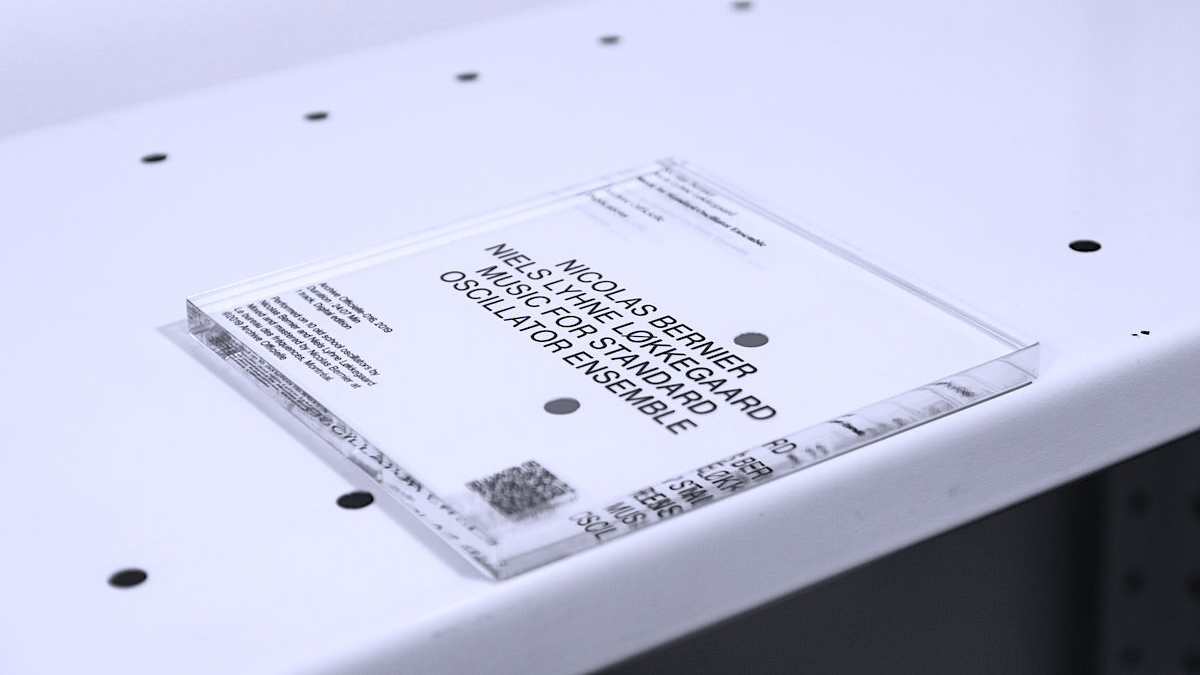
Text score, 2019 (variable duration)
• Nicolas Bernier, Niels Lyhne Løkkegaard: composition• Production, mixing, mastering: Nicolas Bernier
Text score for 10 sine wave oscillators, a minimum of 2 and a maximum of 10 performers. Length of sections and interventions are suggested and certain values in Hertz need to be reached. However, room for improvisation can be found within these guidelines and the final result relies on the arguable randomness of human gesture and timing. This score is included in the digital download on the release published by Archive Officielle.
For oscillators and barython saxophone, 2019 (11')
• Nicolas Bernier, Ida Toninato: composition• Ida Toninato: barython saxophone
• Nicolas Bernier: computer programmming, oscillators
Music for analog osillators and barython saxophone performed at Mutek Festival in August 2019.
Sound performance, 2014 (30')
• Martin Messier, Nicolas Bernier: artistic direction, performance, music
• Jonathan Villeneuve: structure
• Karine Gauthier: lighting
• Jean-François Piché: technical help
• Julie Artacho: photo
• François Laflamme: camera
• Production: 14 lieux
• Support: Festival Sonàr, Festival Maintenant, Conseil des arts et des lettres du Québec et Conseil des arts de Montréal, Conseil des Arts du Canada, Cirque du Soleil
MACHINE _ VARIATION is a project in which Bernier and Messier bring the human body as the crucial element of digital creation. On stage the two performers’ bodies operate and control the creative process by forging direct connections with what we see and hear. The central piece to the performance is a gigantic physical structure built with the artist Jonathan Villeneuve.
For 4 microphones, siren organ and electronics, 2014 (11')
• Sound composition: Nicolas Bernier• Siren organ: Jean-Francois Laporte
Two main themes (the microphone and the movement) are explored in this essay around the organ siren, an instrument built by Jean-François Laporte. The microphone is used to amplify and to create feedback, but also as a mean to generate physical distortion by the friction between the piezo microphone and the instruments. The microphone is also used as a reference to Laporte own work Mantra (1997). The movement is revealing himself by the microphones manipulations, echoed in the gestures of the performer.
_
Produced between March 2013 and June 2014 in the composer's studio and at Totem Contemporain. Thanks to Jean-François Laporte and Conseil des arts du Canada.
Hardanger fiddle and electronics, 2014 (20')
• Sound composition and video animation: Nicolas Bernier• Hardanger Fiddle: Britt Pernille Frøholm
• Video based on a still image by Urban9
Yet they are here. Quiet, unobtrusive, they draw lines between the elements of the story. A necessary presence. Phantom (1651) is a piece of electronic music that tells fragments of a story by the strings of the Hardanger fiddle. Similar to the violin, the instrument commonly used in traditional Norwegian music has this ghostly characteristic: sympathetic strings vibrating by themselves, like spectre. These apparitions are worked on several levels in relationship with the fiddle: inaudible, the instrument will however cause electronic tones, he will be followed by persistent ghostly resonances, he will accidentally trigger accidental sound apparitions. An allegory working around the presence / absence that form a link between the past and the present.
_
Produced between February 2012 and September 2013 in the composer's studio (QC), University of Huddersfield (UK) and NOTaM (NO). Thanks to Britt Pernille Frøholm; Urban9; Monty Adkins; University of Huddersfield • Fonds québécois de la recherche sur la société et la culture (FQRSC) • Pierre Alexandre Tremblay; Olivier Girouard.
A/V Performance w/live electronics, intonarumoris and video, 2010 (30')
• Concept, composition and performance : Nicolas Bernier + Martin Messier• Intonarumoris : Alexandre Landry
• Video footage : Foumalade.org
• Production : Perte de signal
La chambre des machines (The mechanical room) stems from a desire to return to the physical world in an environment of digital creation. Machines made of gears and cranks are manipulated to produce a sound construction at the crossroads of acoustics and electronics. Submerged in sound, the audience discovers the interaction between mechanical and synthetic sound. With specifically tailored programming, digital processing are enlarging the sound palette of the machines.
Mention, Prix Ars Electronica 2011 / AT
Jury Selection, Japan Media Awards 2011 / JP
_
Produced between December 2009 and January 2010 in residency at Perte de signal's Rustines|Lab. Thanks to Perte de signal, Alexandre Landry, Isabelle Gardner, Ekumen, SONAR, MUTEK, Prix Ars Electronica and Transmediale.
audio art ensemble, 2008-2011 (improv)
• Alexis Bellavance, Nicolas Bernier, Érick d'OrionBOLD is an audio art improvisation ensemble formed by Alexis Bellavance, Nicolas Bernier and Érick d'Orion and guests. Inspired by playfulness, the artists are exploring the possibilities of interaction between each other. Through bloody duels, solitary marches and cut-throat trios, they impose their actions as would characters in a Spaghetti Western. Indeed, therein lies the catachresis of the project; it is a movie for the ears, a fictitious soundtrack worthy of cowboy kinetics. From silence to explosion, from long shot to close-up, from well-oiled machinery to haphazard mechanics, from abstract landscape to concrete scenery, from impulsive action to languorous reflection... the language is one of extremes.
Music for folk acoustic guitar, surround sounds and live electronics, 2010 (35')
• Sound composition : Nicolas Bernier• Guitar : Simon Trottier
• Light system : Alexandre Landry
• Visual : urban9
• Commission : Réseaux, Naisa
• Financial support : CALQ, CAC
courant.air is the continuation of a body of work intertwining instrumental and electronic music : a complex and demanding surround sound electronic composition is flowing alongside folk inspired guitar.
Conceptually, the piece is wind powered. Wind is used as a constructive/destructive agent. Wind as a propulsion engine of particles in constant movement in the air. Wind as noise. Wind is sound, invisible.
_
Produced between August 22, 2008 and October 2010 in the composer’s personal studio and in residency at the Banff Centre. Thanks to Simon Trottier, Olivier Girouard, Pierre-Alexandre Tremblay and Alexander Schubert at Ahornfelder, Réseaux and NAISA.
Underwater installation w/ video, 2006
• Concept and sound composition : Nicolas Bernier + Delphine Measroch• 3 channels video : Nicolas Bernier
• Comission : Réseaux
• Financial support : CALQ
sub•a•quat•ic is a sound installation proposing a unusual way of experiencing music: the underwater listening. Submerged in water, it’s the entire body which perceives the music, the sound seeming as if coming directly from inside the skull. The aquatic world also perturbs and blurs the music. What the listener perceives becomes a difformed reality which can seem strangely faint and distant, as would do memories.
The listener-swimmer choses its own journey, hovering at the surface where both spaces merge, or dives in one world to then re-emerge in the other.
Selection, IMEB Bourges, 2007 / FR
Music/Video Trilogy, 2004-2005
• Video and sound composition : Nicolas Bernier + Delphine Measroch
except Treelogy II This Is A Portrait by Nicolas BernierTreelogy is a serie of three eulogy-movies around discreet movements and growing things. The project, in the first place, was meant to be purely aestetic, witnessing our fascination for the open landscapes. It is a tribute to the "micro but not quite invisible" movements which appears when we stop to catch them.
Treelogy I : She Under A Sherrington Tree (2004) 8'
Treelogy II : This is a Portrait (2005) 8'
Treelogy III : Orchid (2005) 3'30
Nomination, Qwartz 2009, Treelogy III / FR
Prize, Visionaria 2005, Treelogy II / FR
1st prize, Visionaria 2004, Treelogy I / IT
Best Video Art, Chicago Motion Graphic 2004, Trelogy I / US